

Note: this is not a conspiracy article. I’m not alleging foreknowledge of the 9/11 attacks on the part of any artist or group that I write about; I’m merely reflecting on uncanny, apparent foreshadowing in a small fraction of the art connected to the artist-in-residence program that existed in the North Tower of the New York World Trade Center at the time of its destruction in the attacks. I discuss my thoughts on the speculative origin of such foreshadowing at the end of the article. No disrespect is meant to any of the artists, the victims, or their families.
When I was a child, I caught a fleeting glimpse
Out of the corner of my eye
I turned to look, but it was gone
I cannot put my finger on it now
The child is grown, the dream is gone.

-Pink Floyd (lyrics by Roger Waters), Comfortably Numb, 1980
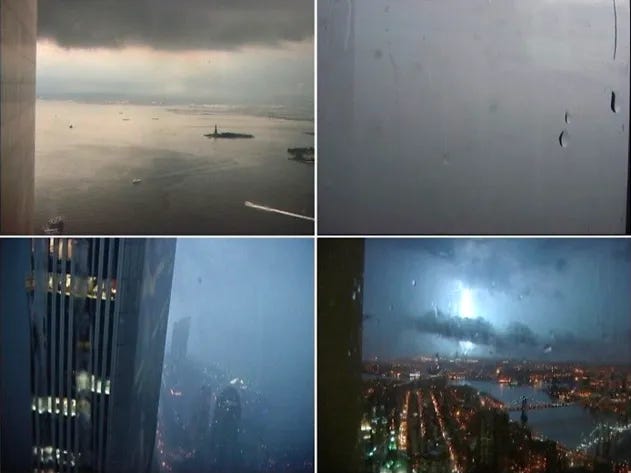
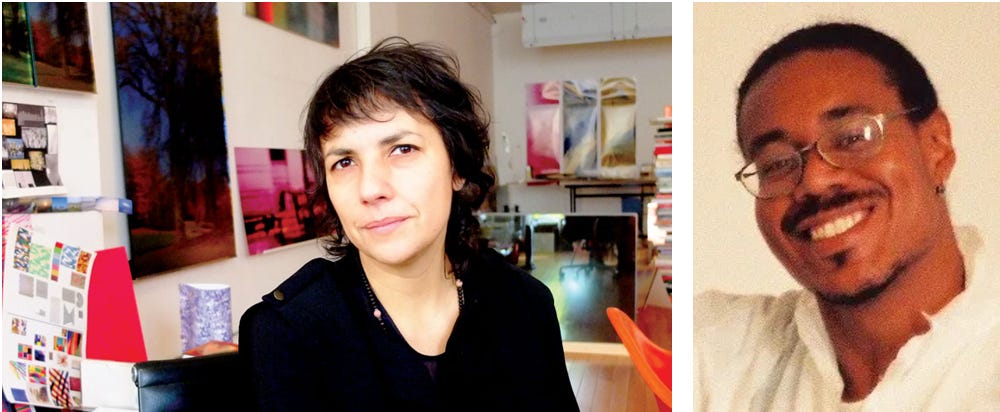
On the evening of September 10, 2001, a fierce storm system lashed the island of Manhattan, bringing lightning, wind, and rain. 37-year-old artist Monika Bravo was working in her studio on the 92nd floor of One World Trade Center, often referred to as the “North Tower”, when she set up her video camera to capture the first moments of the storm’s arrival, around 3 in the afternoon. She took seven hours of time-lapse footage, later edited into five minutes of video, as successive waves of storms rolled through into the night. Bravo’s video would be the last footage ever captured from inside the structure that had occupied that location since 1971, but would occupy it no longer.
When I discovered her film a year or so ago on Vimeo, until recently the only site where it had been accessible since 2011, I was astounded. The events surrounding the twin towers on 9/11 are too dark and impenetrable for the human mind to fully comprehend. On social media I’d sometimes come across tourist images or videos from the buildings captured in the weeks or months prior to the event and would read the comments about how eerie it was to see these. But now here was video shot from the very zone of the first plane’s impact on the day before — on the very night before — looking out at a stormy, foreboding world on the cusp of ceasing to exist. The metaphor it represented was unmistakable, and I couldn’t believe I’d never known about it. (Since learning of Bravo’s film, I’ve discovered a half-dozen or more other images and videos from that night and early the next morning, before the initial attack, but her film remains the most iconic and impactful to me).
Titled September 10 2001, Uno nunca muere la vispera, which translates to “one never dies the day before [their death]”, the film transitions from a whiteout title screen to an opaque grey as the opening bars begin to play of the downtempo lounge track Summer in San Tropez, from a 2000 collaboration called Flora & Fauna. You realize there’s movement in the grey and an indistinct horizon. A droplet of rainwater streaks the glass pane you now realize is in front of the lens. Then another droplet, and another.
What you’re seeing are rain-laden clouds passing over New York Harbor and then the East River on the afternoon of September 10th, the camera alternating between south- and east-facing windows of the 92nd floor of the North Tower. On occasion, the west facade of the South Tower is visible to the left and a drab, indistinct Statue of Liberty pokes up like the pointy end of a thumb tack into the mist from a darkened Liberty Island in the far distance.
Monika Bravo’s film:
At about a minute in, the film cuts to sepia-toned timelapse footage of the storm’s approach just as the music takes on a lighter tone, incongruous with the foreboding images. This somehow makes it more unsettling. Dark clouds rush up from the southwest and overtake the tip of Manhattan, interspersed with sunlight. The splotchy surface of the harbor looks like a calico cat in motion as cloud and sun compete to reflect off of it. A similar view across the East River shows the time-lapse boat trails crisscrossing up and down until the mist fully obscures them as the first wave of storms sets in.
When night has fallen, direct shots of the South Tower become visible through the rain and lightning. The video image drifts out of focus at times, only to snap back into sharpness moments later. An unexpected one-second zoom-in to the face of the tower at the 2:22 mark is jarring and seems an odd and slightly irreverent choice of edit. You can see empty desks and chairs on lighted floors opposite, beyond what are now rivulets of rainwater streaming down the window in front of you and down those soon-to-be-infamous aluminum-clad columns to the side of the frame.
It was near midnight before Bravo collected her footage and headed home, leaving fellow artist Michael Richards, a sculptor, on the 92nd floor as he watched the end of the Giants-Broncos game on Monday Night Football. Richards would stay overnight working on his own project. He would be killed the next morning after an American Airlines Boeing 767 slammed into the north face of the tower at 8:46 a.m., leaving a black, smoking gash from Floors 93 to 99, filling the stairwells and elevator shafts with debris extending down into the levels below.
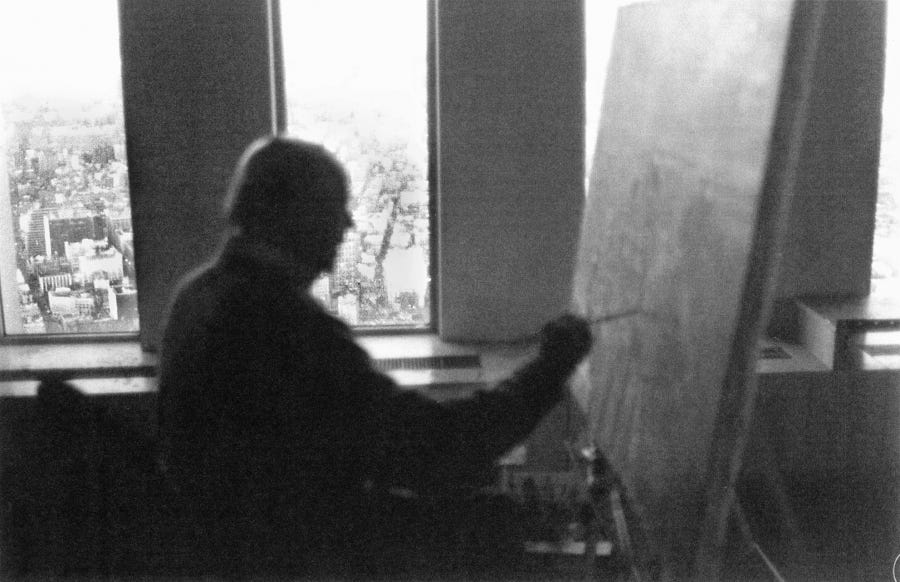
Richards and Bravo were just two of about 20 artists in the Lower Manhattan Cultural Council’s (LMCC) World Views artist-in-residence program that for four years had occupied studios on the the 91st and 92nd floors of the North Tower. Richards would be the only member of the program to be killed in the attacks. He was working on a memorial to the Tuskegee Airmen, the famous unit of decorated Black pilots from World War II. His unfinished piece lost in the building’s destruction depicted an airman riding a meteor.
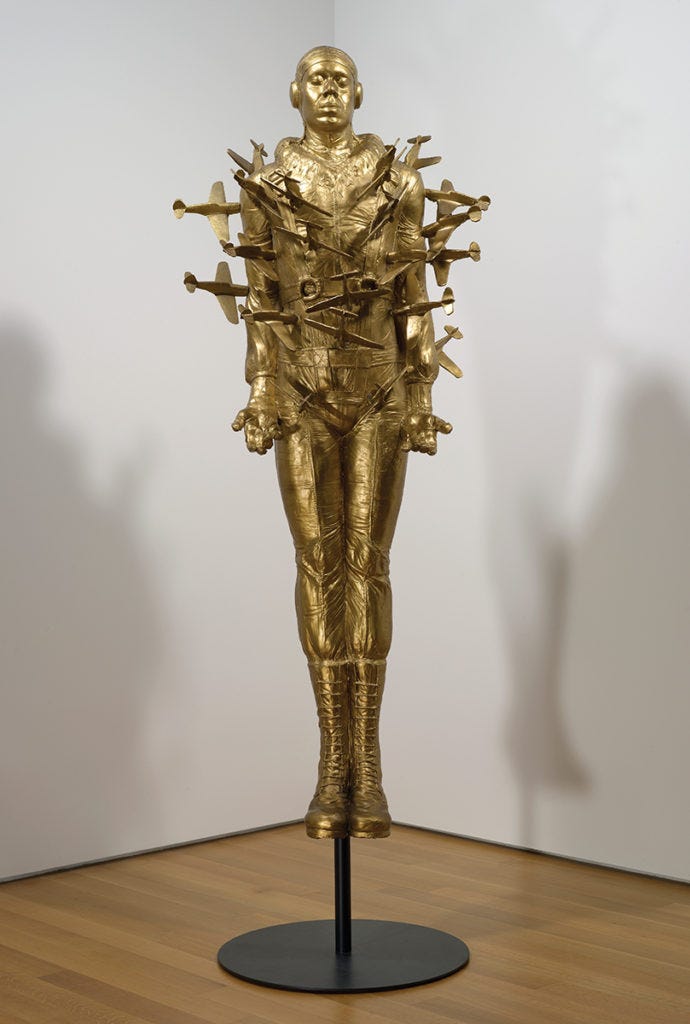
One of Richards’ prior pieces from the same series, titled Tar Baby vs. St. Sebastian, featured a suspended airman in flight suit, eyes closed and palms open outward, with a swarm of fighter planes impacting his body from multiple directions. St. Sebastian was a Christian martyr traditionally shown pierced by arrows. This imagery drew from the history of the Tuskegee Airmen and broader themes of Black identity, vulnerability, and heroism.
Richards had used his own body as a model for the airman. “The idea of flight relates to my use of pilots and planes, but it also references … the idea of being lifted up, enraptured, or taken up to a safe place — to a better world,” Richards wrote. These weren’t Richards’ only works containing elements that seemed to anticipate the circumstances of his fate.
These elements are framed in Carl Jung’s depth psychology using the concept of “synchronicity”, referring to coincidental events that appear meaningfully related but do not seem to be causally connected, taken by Jung’s psychoanalytic theory to be evidence of a connection between the mind and material objects. Some who take the theories seriously believe those with artistic minds may be uniquely adept at picking up synchronistic patterns, even precognitive ones, in the spaces they inhabit and the objects they create.
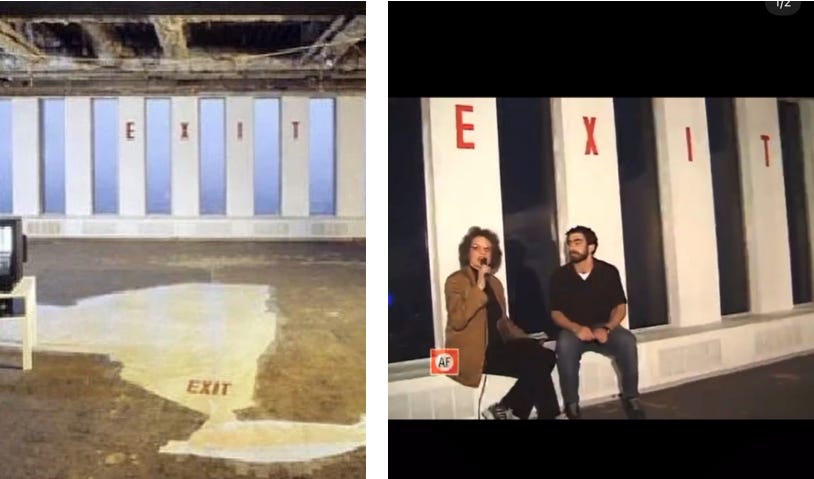
2001 arts program interview of an LMCC staff member in the WTC:
Such apparent pattern recognition, or “pre-reflection”, among artists in the World Views program didn’t stop with Richards. An art collective called “E-Team” who were part of the residency in early 2001 did two projects that still raise eyebrows (and, among some, suspicions).
The first, 127 Illuminated Windows, in March 2001, involved treating the upper north face of the North Tower like the face of an LCD screen by having businesses occupying adjacent offices on floors 89-95 selectively turn lights on or off for the night to spell out the name of the collaborative - E-TEAM - in giant block letters. What made this project significant in retrospect was the fact that the floors used for the display closely approximated those that were impacted by the first plane to attack on 9/11 (floors 93-99), and on the same face of the tower.
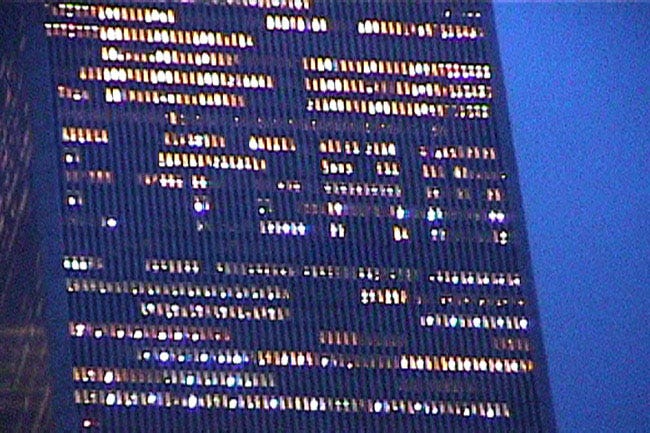
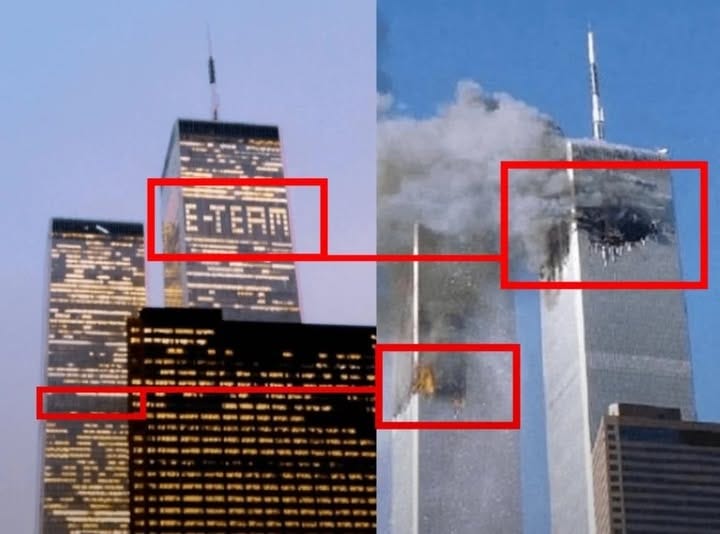
The second E-Team project to draw retrospective scrutiny was Quick Click, a project related to the Open Studios open-house event for the LMCC World Views program that was held on a Saturday in late March, 2001. This is probably the second-most unsettling event tied to the program in the year-and-a-half leading up to 9/11.
Members of the public lined up along the north-facing windows of the 91st floor of the North Tower and awaited their turn to have their photos snapped from a helicopter hovering outside for 20 minutes (see video below). When it was their turn, each individual would step up into a lighted window, pose for a few seconds, and step down to let the next person take their turn. The whole thing was coordinated by E-Team members with handheld radios. People could return the next day to pick up their photos.
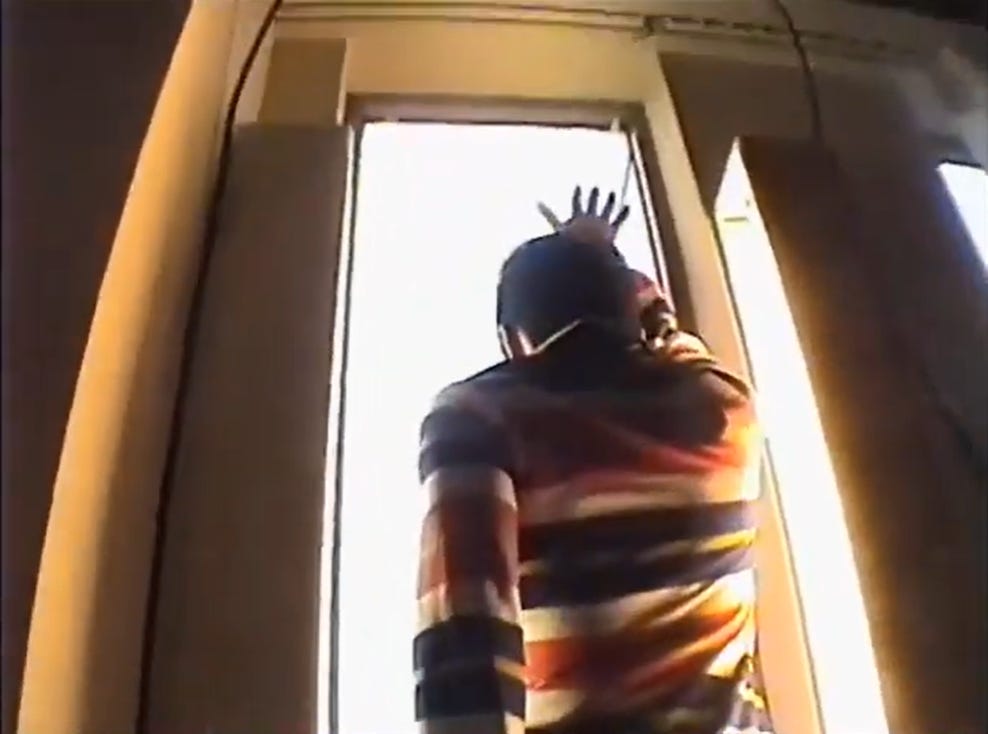
I’ve yet to find a single example of an individual photo from this event, but the imagery from the video of it is unnerving. Seeing illuminated human forms standing between the columns on the same face of the building, and only a few floors below, where desperate people gasping for air would lean out of broken and blackened windows less than six months later is almost too unsettling to watch.
What sense did this kind of display make, even in hindsight, as an artistic expression? Judging from the poor-quality video image, the photographic effect couldn’t have been that good. The lighting appears to have been inadequate. The distance of the helicopter from the building would have prevented a stable, closeup shot. The whole thing seems only to have meaning when considered in light of subsequent events, which makes it all the more disturbing.
Short video documenting the Quick Click project, apparently created by E-Team:
But, with the exception of the helicopter, Quick Click happened inside the building. A year prior to that project, there was another one by a different artist group that “pierced the veil” of the building and extended strikingly similar symbolic imagery to its outside. This is by far the most astounding and unsettling example of WTC art imitating, in advance, the horrific real-world life of the building’s near-future. And it’s almost unbelievable that it actually happened.
The Austrian art collective Gelitin are known for their performative, often absurdist projects that blend sculpture, action, and prank-like gestures. Their later work, Rabbit, in 2005, saw them create a giant, cartoonish, pink bunny figure on a mountainside in Italy, knitted from wool and stuffed with hay. It was intended to last until 2025 but had all but rotted away by 2016.
During their residency at World Views in early 2000, it’s unclear what kind of project they were supposed to be working on, but the one they ended up doing was shrouded in controversy and intrigue, and fuels conspiracy theories to this day.
The B-Thing, performed in March 2000, involved the group secretly removing a window pane on the 91st floor from the inside using putty-stripping and suction-cup equipment, and then extending outside the building a small, load‑bearing balcony made from materials they smuggled in (artists in the building apparently had free reign at all hours of the day and night). At dawn on March 19th, each member stepped onto the balcony—at least one of them wearing angel wings — while a helicopter hovered nearby, documenting the moment in a series of haunting photographs. They then removed the balcony, resealed the window, and kept the operation so secret that it sparked rumors and disbelief across New York’s art circles.
They published a now-out-of-print, limited-edition art book about the feat on January 1, 2001, which today costs thousands of dollars to purchase on Amazon and eBay. Although there was a time early on when even Gelitin themselves denied having done it (probably to avoid legal consequences), experts analyzing the photos found no signs of digital tampering—confirming the stunt’s authenticity. Numerous articles have been written about it, including most-recently in Rolling Stone.
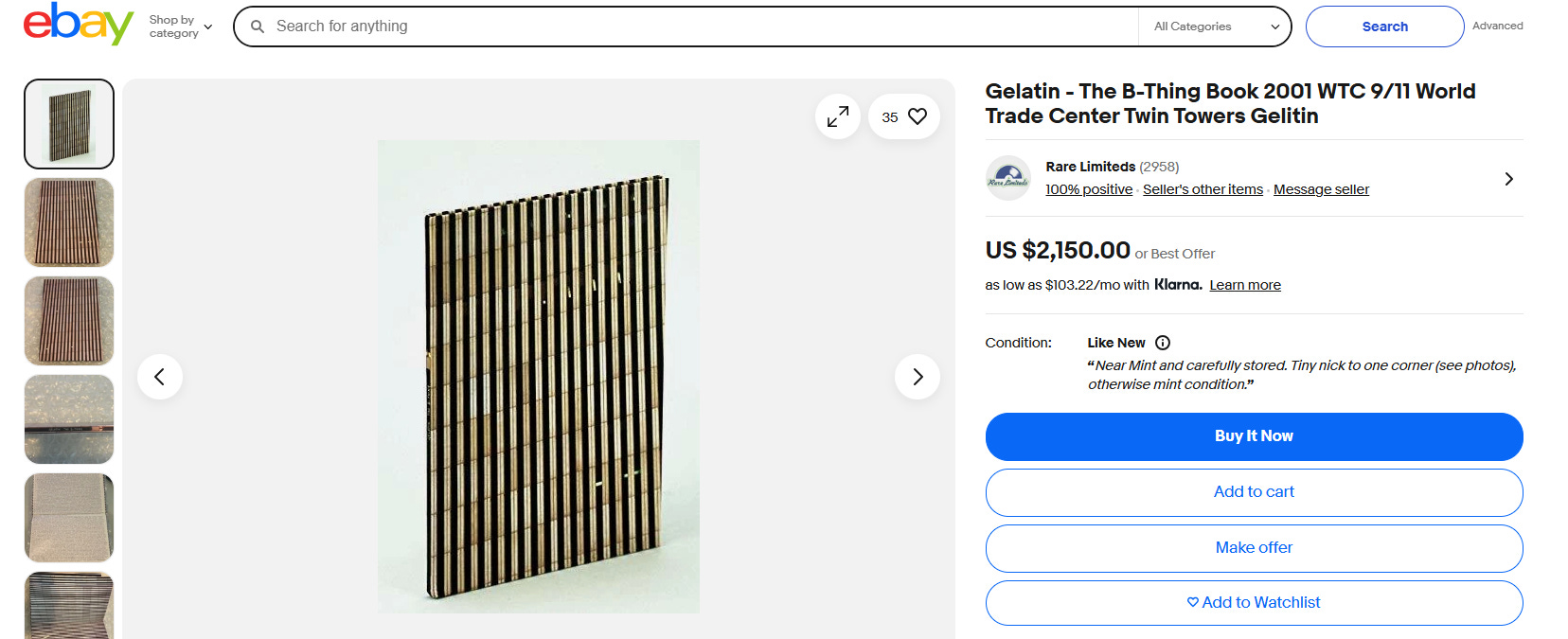
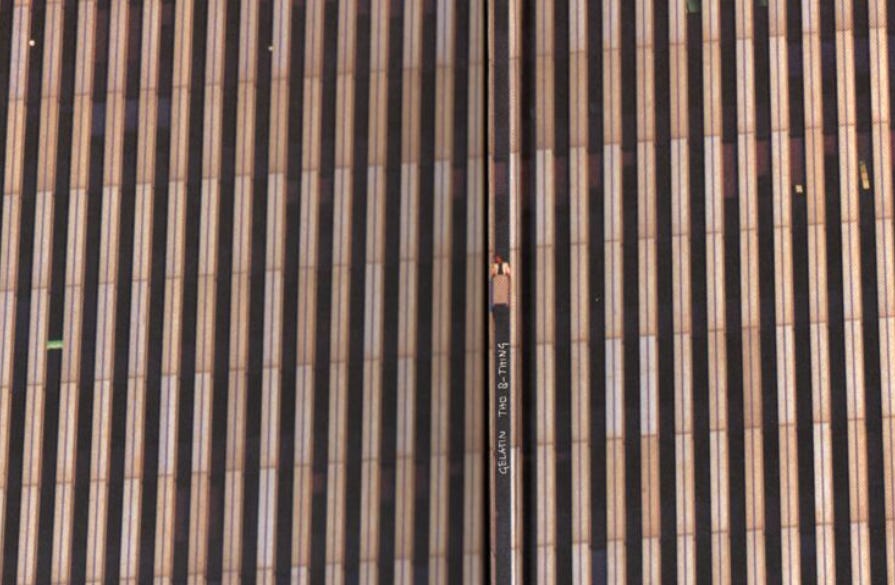
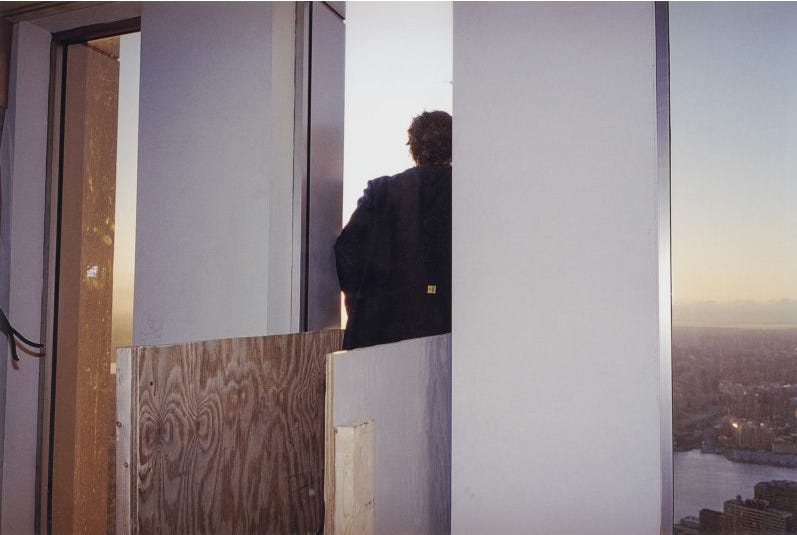
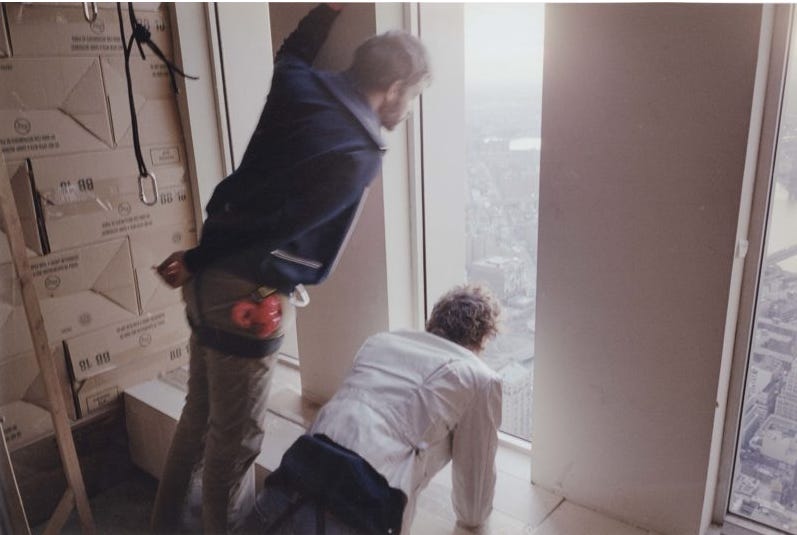
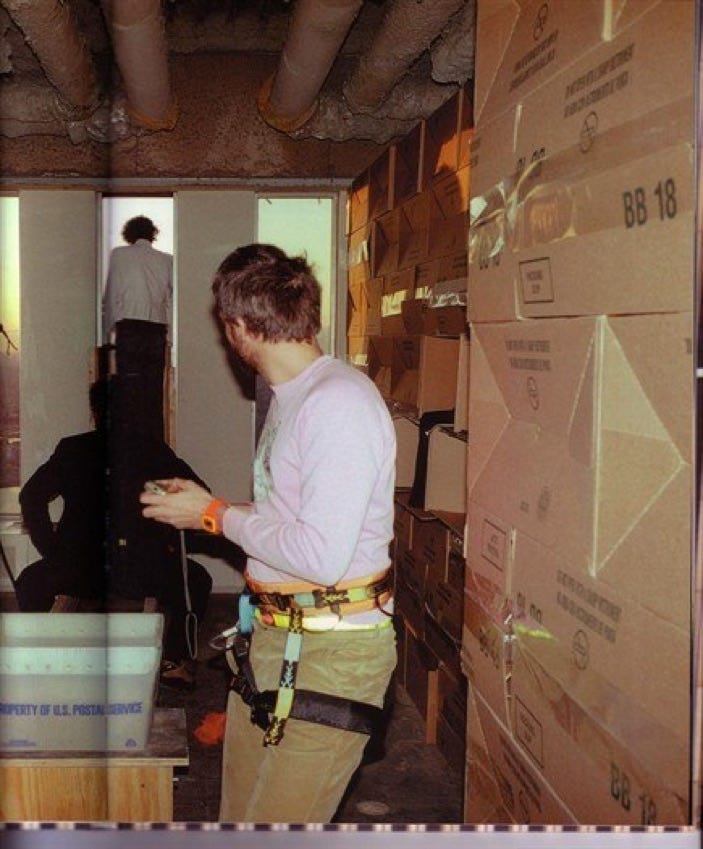
Incredibly, Gelitin had a gallery exhibition scheduled to open on September 11, 2001, in New York that was to include documentation from The B-Thing (photos, concept material), which was either delayed or overtaken by the events of the day.
Understandably, conspiracy theorists (and I don’t consider that term to be derogatory, as it describes me on occasion) have pounced on all aspects of this stunt as evidence of foreknowledge of 9/11. They often conflate Gelitin and E-Team and mis-identify photos of Gelitin preparing their stunt as being members of E-Team. The name “E-Team” is said to be a not-so-subtle reference to the artists being members of an explosives team preparing the building for demolition.
Gelitin built a temporary wall around the 91st-floor area where they constructed their balcony using discarded cardboard boxes. They called this makeshift concealment device “the Trojan box”. Conspiracists zero in on the fact that all of the boxes used to construct the Trojan box were identical in size, shape, and labeling and contained writing on them (including the alphanumeric characters “BB 18”) that indicated they had all contained fuse holders, or related components, manufactured by a company called Littelfuse. An internet search shows these are used in electronics and control panels, or small appliances. I found nothing to say they’re used in controlled demolitions, but you get why something like that would draw suspicion.
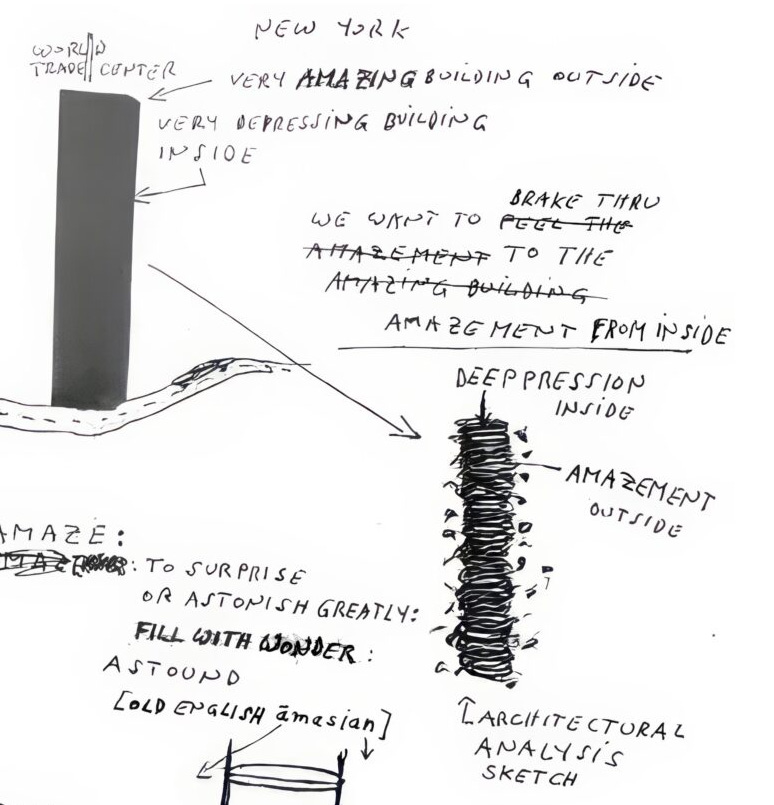
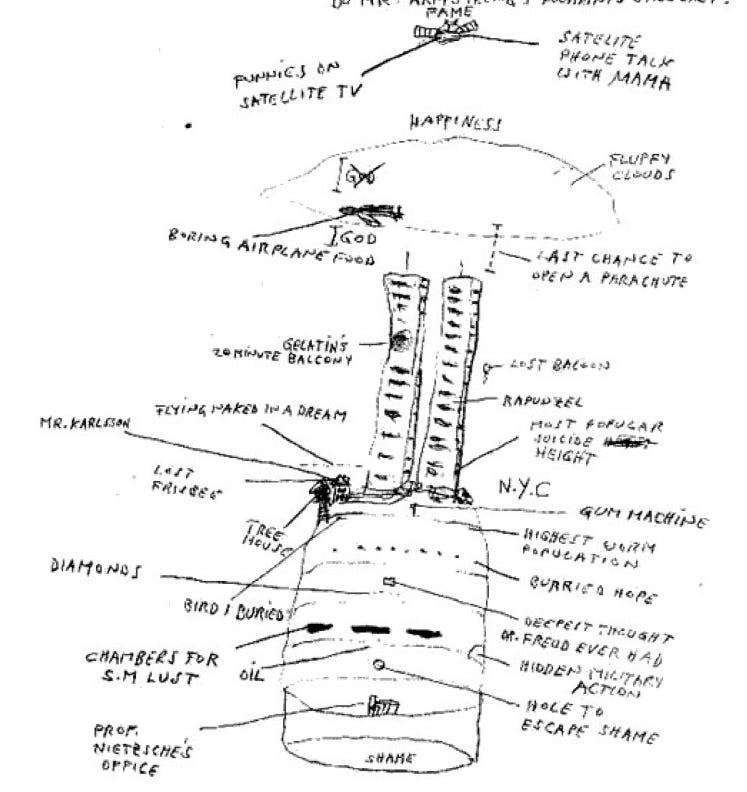
It’s apparently common practice for Gelitin to include crude sketches and scribbled themes, many of them cryptic, in relation to the projects they do, often as an integral part of the published project. The B-Thing was no exception. The book contains more disturbing imagery in light of the context.
In one sketch, one of the WTC towers is labeled “VERY DEPRESSING BUILDING INSIDE” and “VERY AMAZING BUILDING OUTSIDE”, and “WE WANT TO BRAKE THRU [SIC] TO THE AMAZEMENT FROM INSIDE.” The sleek tower is juxtaposed with a more impressionistic version scribbled on the same page, with scribbled pen marks up and down the outside surface of the building (below). One can use his imagination to picture what this resembles.
Another sketch depicts both towers, the sky above them, and multiple layers of ground below, all annotated with miscellanea. At the top, a satellite with the caption “SATELITE [SIC] PHONE TALK WITH MAMA.” Underneath it, a plane skims below “fluffy clouds”. The space between the cloud deck and the top of the buildings is labeled “LAST CHANCE TO OPEN A PARACHUTE.” Gelitin’s makeshift balcony from the stunt is depicted. Three or four layers underground, in a small corner below the building, is an area labeled “HIDDEN MILITARY ACTION.”
Is the unease we feel with these videos and images only because we’re viewing them in hindsight, after the unspeakable tragedy of 9/11? Was that event so horrible that maybe we (I, at least) inappropriately paint every cryptic, artistic allusion with the colors cast by that day? Maybe. It’s easy to forget that in 2001 the World Trade Center had already been the site of terrorism — in 1993, when a car bomb attributed to Middle East terrorists detonated below the North Tower, killing 6, injuring thousands, and doing $250 million worth of damage. The memory of this event alone could have contributed to the mood of the artists working at the site and affected their art.
And beyond the direct terrorism connections, it’s important to remember how most of the artists felt in a general sense about this stripped-down, corporatist, sterile space they found themselves working out of. It was like a giant version of the quintessential cubicles from the 1999 Mike Judge film Office Space, only with a magnificent view between and beyond the overbearing columns. The buildings were 30 years old by then and already antiquated, full of asbestos and lacking in occupants. Seen in this light, Gelitin’s scribbles about breaking trough to the amazingness outside doesn’t seem so sinister.
But… but… but…the impossibly eerie Quick Click photo project…the jaw-dropping coincidence of Gelitin’s figure on the balcony, dressed in angel’s wings, and their bizarre captions referencing phone calls to family members and parachutes…the unbelievable symbolism of Michael Richards’ Tar Baby vs. St. Sebastian and related works…and even something so simple as the artistic red EXIT someone painted over the 91st floor windows. These things are just…weird — hindsight or no. Monika Bravo’s symbolic storm seems a perfect, poetic finale to this harbingers’ parade.
I’ll never reconcile it all in my head. I can’t help but wonder, somewhere in the back of my mind, whether E-Team, Gelitin, or both groups had actual knowledge of something coming or were led to their themes by someone who did. But I’m aware of no evidence of that whatsoever beyond their art itself, and so I have to tell myself it’s either all a very strange coincidence or some kind of metaphysical artistic intuition. None of these explanations satisfies me, and that’s what keeps bringing me back — the need to know — knowing that the need will remain forever unmet.
Monika Bravo’s film ends with a tribute to her friend:
MICHAEL:
wherever you are,
this one is for you.
Richie Graham is based in Little Rock Arkansas USA and writes from a free-market libertarian, anti-interventionist perspective.